
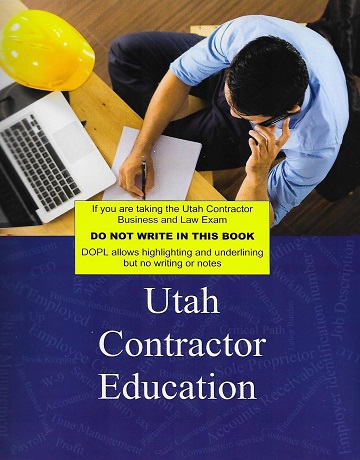
UTAH Contractor Education 12th Edition
The UTAH Contractor Education 12th Edition is developed as a state‑specific educational resource tailored for individuals preparing for the contractor licensing process in Utah. It covers the business, law, and regulatory aspects relevant to becoming a licensed contractor in the state, aligning with the requirements of the Utah Division of Professional Licensing (DOPL) and other regulatory frameworks. The text offers a mix of theory and practical guidance—discussing business operations (such as entity structure, insurance, and accounting), legal obligations (licensing laws, lien laws, contracts), project management fundamentals (estimating, bidding, subcontracting), and safety/regulatory subjects (OSHA, environmental considerations). It is designed to help candidates understand both the administrative and on‑the‑job responsibilities associated with contracting in Utah, and to prepare them for the required examinations.
$145.99
Book Overview
The UTAH Contractor Education 12th Edition is a comprehensive, state‑specific textbook tailored for contractors in Utah. It addresses the dual imperatives of running a successful contracting business while complying with the legal and regulatory framework governing the industry in the state. Organized into three major parts, the book begins with business planning and startup, guiding readers through the development of a business plan, choice of business entity (such as sole proprietorship, LLC, or corporation), licensing and insurance requirements unique to Utah and early marketing and management issues. The second part presents the fundamental operational aspects of a contracting enterprise—estimating costs, bidding projects, contract negotiation and management, scheduling, project management techniques, and jobsite responsibilities including safety, environmental concerns and relationships with employees, subcontractors and suppliers. The final section focuses on administrative and compliance tasks that are critical for long‑term viability: financial management (cash flow, bookkeeping, financial statements), tax issues, lien law and other legal obligations, bond and insurance considerations, regulatory oversight and risk management. Because the book is aligned with the state’s contractor licensing examination (Business & Law component) and the pre‑licensure training requirements, it also serves as a core study reference. As such, it presents content in a manner that not only informs business operations, but also supports exam preparation by emphasizing the regulatory and legal requirements of the state of Utah. The result is a practical, integrated resource that blends business strategy, project management practices, and law‑and‑compliance essentials into a unified guide for aspiring and established contractors in Utah.
Key aspects:
- Focuses on business startup and management for construction‑contracting operations: business planning, entity selection (LLC, corporation, partnership), licensing, insurance and bonding.
- Covers fundamentals of operating a contracting business in Utah: estimating, bidding, subcontracting, scheduling, quality, safety, project documentation.
- Explains the legal and regulatory environment in Utah: contractor licensing law, lien law, contracts, business law, employment and tax issues.
- Provides administrative‑management content: financial management, tax basics, bookkeeping, risk management, change orders, project close‑out.
- Tailored specifically to Utah rules and licensing requirements (e.g., pre‑licensure training for the Utah Division of Professional Licensing (DOPL) Business & Law exam).
- Designed for both new contractors and those already in the business who wish to stay compliant and profitable.
Highlights:
- State‑specific: The content aligns with Utah statutes, rules and contractor exam requirements (helping exam candidates and business owners alike).
- Practical orientation: Many real‑world examples, case scenarios and business‑management tools relevant to a contracting enterprise.
- Balanced mix of business, law, and project‑management content—reflecting the tripartite nature of running a contracting firm.
- Emphasis on risk mitigation: insurance, bonds, lien laws, regulatory compliance—all critical in the contracting world.
- Resource for exam prep: Often used in pre‑licensure courses (25‑hour/30‑hour) for general contractors in Utah.
- Helps bridge theory and practice: not just “what the law says” but “how you apply it in your business and on jobsites”.
About Ross Ford
Ross Ford has extensive experience in the construction industry in Utah, having spent over 20 years working as a licensed general contractor in both residential and commercial projects, including framing, finish carpentry, concrete work, architectural millwork, and large‑scale developments. He has also served in educational leadership roles: for example, as Apprenticeship Director and Career & Technical Education Director at Utah Valley University, where he oversaw curricula across trades, managed grant funding, and coordinated with industry and regulatory bodies. Furthermore, Ford holds academic credentials in Technology Management and Construction Management, is a certified NCCR Master Trainer, and has held numerous industry and regulatory leadership positions including membership on state committees dealing with building code, licensing, and education.
Other Works:
Specifications
| Weight | 3 lbs |
|---|---|
| Dimensions | 9 × 8.5 × 1.5 in |
- Publisher: National Association of State Contractors Licensing Agencies (NASCLA)
- Edition/Release Date: 12th Edition, July 17, 2025
- ISBN: 9798987814239
- Pages: 276
- Format: Paperback / Softbound
- Target Audience: Professionals
Based on 0 reviews
Be the first to review “UTAH Contractor Education 12th Edition”
Related products
-
Construction, Industries, Plumbing, States, West Virginia
Pipefitting Level 3 Trainee Guide, Paperback, 4/E
 Construction, Industries, Plumbing, States, West Virginia
Pipefitting Level 3 Trainee Guide, Paperback, 4/E
Describes the use and inspection of basic equipment and hardware used in rigging, including slings, wire rope, chains, and attaching hardware. Explains sling angles. Describes the use of tuggers, jacks, hoists, and come-alongs.
SKU: 9780137487288 -
-

There are no reviews yet.