
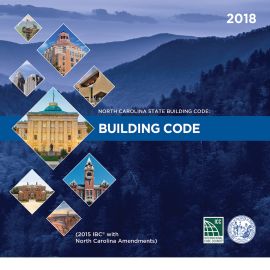
North Carolina State Building Code: Building Code 2018 – Loose Leaf
The North Carolina State Building Code: Building Code 2018 is a comprehensive set of regulations governing the design and construction of buildings in North Carolina. Adopted by the North Carolina Building Code Council and based on the 2015 International Building Code (IBC), it incorporates state-specific amendments to address local conditions and requirements.
$185.99
Book Overview
The North Carolina State Building Code: Building Code 2018 serves as the primary reference for architects, engineers, contractors, and code enforcement officials in North Carolina, ensuring that buildings are constructed safely, efficiently, and in compliance with state regulations.
Key Aspects:
- Scope: Applies to all buildings and structures, including commercial, industrial, and multifamily residential buildings.
- Structure: Organized into chapters covering various aspects of building construction, such as occupancy classifications, building heights and areas, fire protection systems, structural design, and means of egress.
- State Amendments: Includes modifications to the IBC to align with North Carolina’s specific needs, including considerations for local climate, geography, and safety concerns.
- Referenced Standards: Incorporates standards from organizations like the National Fire Protection Association (NFPA) and the American Society of Civil Engineers (ASCE) to ensure comprehensive safety and performance criteria.
Highlights:
Scope and Composition
- The 2018 NC Building Code is derived from the 2015 IBC, tailored with state-specific amendments to address local regulatory and safety needs.
- It applies to commercial and multifamily construction statewide, while the 2018 Residential Code covers single- and two-family dwellings separately.
Accessibility Standards
- For accessibility, the code retains the use of ANSI A117.1‑2009, aligning North Carolina’s standards with federal accessibility requirements.
Implementation Timeline
- A transition period was in place from July 1 to December 31, 2018, after which the 2018 code became fully effective on January 1, 2019
About ICC
International Code Council is a leading organization dedicated to developing a single set of comprehensive, coordinated national model construction codes. To date, 48 U.S. states have adopted various international codes from the International Code Council.
Other Works:
| Weight | 8 lbs |
|---|---|
| Dimensions | 13 × 12 × 6 in |
- Publisher: International Code Council
- Edition/Release Date: 2018, (July 1, 2018)
- ISBN: 978-1609838348
- Pages: 732
- Format: Paperback
- Target Audience: Professionals
Based on 0 reviews
Be the first to review “North Carolina State Building Code: Building Code 2018 – Loose Leaf”
Related products
-
Business and Law, Connecticut, Construction, Industries, States
Connecticut Contractor Guide to Business and Project Management 6th Edition
 Business and Law, Connecticut, Construction, Industries, States
Connecticut Contractor Guide to Business and Project Management 6th Edition
- The Connecticut Contractor Guide to Business and Project Management 6th Edition is a comprehensive resource designed to assist contractors in understanding the legal and business aspects of operating in Connecticut. This guide is particularly useful for those preparing for the Connecticut Business and Law Examination.
SKU: 9781948558235 -
Business and Law, Construction, Industries, South Carolina, States
South Carolina, Contractors Guide to Business, Law – Residential
 Business and Law, Construction, Industries, South Carolina, States
South Carolina, Contractors Guide to Business, Law – Residential
South Carolina, Business and Project Management for Contractors, Residential Contractors edition is designed to provide an overview of business management subjects for general contractor examination candidates applying for a license from the South Carolina Licensing Board.
SKU: 1948558068 -
Code Books, Construction, Electrical, Industries, Nevada, States, Virginia, Washington D.C.
2011 National Electrical Code
 Code Books, Construction, Electrical, Industries, Nevada, States, Virginia, Washington D.C.
2011 National Electrical Code
NFPA 70®, National Electrical Code® (NEC®), is the authoritative document addressing electrical installations in residential, commercial, and industrial settings. The NEC is revised every three years to stay in sync with industry practices, emerging trends, and the development and introduction of technologies to provide comprehensive rules for designers, installers, inspectors, engineers, electricians, and anyone else who works in the electrical industry. The code is organized for ease of use.
SKU: 7011SB -
Business and Law, Construction, Industries, States, Virginia
Virginia, NASCLA Contractors Guide to Business and Project Management, 11th Edition
 Business and Law, Construction, Industries, States, Virginia
Virginia, NASCLA Contractors Guide to Business and Project Management, 11th Edition
Virginia, Business and Project Management for Contractors, Commercial Contractors edition is designed to provide an overview of business management subjects for general contractor examination candidates applying for a license from the Virginia Licensing Board.
SKU: 9781948558457
There are no reviews yet.