
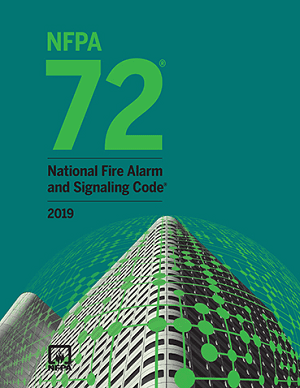
NFPA 72, National Fire Alarm and Signaling Code, 2019 Edition
Get insights on the latest requirements for the design, installation, inspection, testing, and maintenance of fire alarm and emergency communications systems. The NFPA 72: National Fire Alarm and Signaling Code is the standard that provides requirements that reflect the needs and concerns of code users in the field today. Consult the most advanced and comprehensive requirements ever developed for the application, installation, location, performance, and inspection, testing, and maintenance (ITM) of fire alarm and emergency communications systems, including mass notification systems (MNS), used to protect life and property.
$208.99
Book Overview
Changes to the 2019 edition of NFPA 72, National Fire Alarm and Signaling Code, include:
- Significant expansion of the scope of NFPA 72 to now address carbon monoxide protection
- Relocation of material previously in NFPA 720, Standard for the Installation of Carbon Monoxide (CO) Detection and Warning Equipment, into the 2019 edition of NFPA 72 (Critical requirements are incorporated into Chapter 17 for carbon monoxide detectors, Chapter 14 for installation, testing, and maintenance, Chapter 29 for carbon monoxide alarms, and new Annex H.)
- Added testing requirements for energy storage systems (ESS)
- New requirements for HVLS fans and air-sampling smoke detectors
- Major revisions to the requirements for fire service access elevators and occupant evacuation elevators (OEE) to coordinate with changes made in ASME A17.1/CSA B44. Annex text added for clarification.
- Extensively revised requirements for occupant evacuation operation (OEO) coordinated with the new best practices and field research
- Revised Chapter 24, now including requirements for stairway communications systems, elevator landing communications systems, and occupant evacuation elevator lobby communications systems, in addition to revised requirements for area of refuge (area of rescue assistance)
- Revised Chapter 14, Inspection, Testing, and Maintenance, now incorporating valve-regulated lead-acid (VRLA) batteries
- New and updated definitions to bring NFPA 72 up to date with current technologies (For example, the terms strobe, light, and visible have been changed to visual notification appliance, recognizing the use of LED products that can be used for fire alarms.)
About NFPA
NFPA is known as the trusted source of safety knowledge, the National Fire Protection Association (NFPA) has been helping to solve some of the planet’s toughest safety problems for more than 125 years. To remain relevant for over a century as a knowledge and information organization, we’ve continually evolved our scope of expertise—from fire prevention, wildfire preparedness, and electrical safety to hazardous materials, community risk reduction, and public safety.
Other Works:
Specifications
| Weight | 2.11 lbs |
|---|---|
| Dimensions | 11 × 8.5 × 1.5 in |
- Publisher: NFPA
- Edition/Release Date: September 28, 2018
- ISBN: 9781455920563
- Pages: 396
- Format: Paperback / Softbound
- Target Audience: Professionals
Based on 0 reviews
Be the first to review “NFPA 72, National Fire Alarm and Signaling Code, 2019 Edition”
Related products
-
Business and Law, Construction, Industries, States, Virginia
Virginia, NASCLA Contractors Guide to Business and Project Management, 11th Edition
 Business and Law, Construction, Industries, States, Virginia
Virginia, NASCLA Contractors Guide to Business and Project Management, 11th Edition
Virginia, Business and Project Management for Contractors, Commercial Contractors edition is designed to provide an overview of business management subjects for general contractor examination candidates applying for a license from the Virginia Licensing Board.
SKU: 9781948558457 -
There are no reviews yet.