
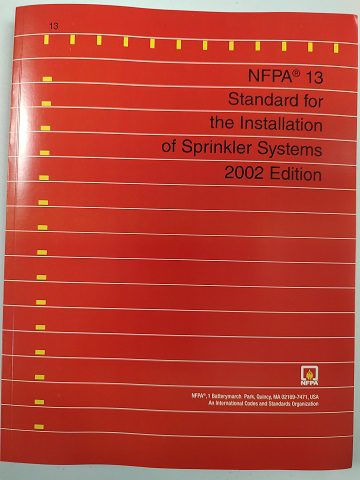
NFPA 13 Standard for the Installation of Sprinkler Systems,2002
Help ensure safe and effective installation of sprinkler systems with NFPA 13, Standard for the Installation of Sprinkler Systems.
Changes to the 2002 edition of NFPA 13, Standard for the Installation of Sprinkler Systems, include:
- Improved access to information by consolidating storage design requirements and approaches into Chapter 12: General Requirements for Storage
- New chapter entitled Special Occupancy Requirements with extracts of sprinkler system requirements from more than 30 NFPA® codes and standards for convenient referencing
- Update that all applicable provisions for underground piping—including materials, installation, and acceptance testing—are presented in Chapter 10, which coordinates with NFPA 24, Standard for the Installation of Private Fire Service Mains and Their Appurtenances
- Expanded tables for Early Suppression Fast Response (ESFR) sprinklers to allow you to choose the storage and building height for any arrangement
$203.99
Book Overview
The industry benchmark for design and installation of automatic fire sprinkler systems, NFPA 13 addresses sprinkler system design approaches, system installation, and component options to prevent fire deaths and property loss.
Changes to the 2002 edition of NFPA 13, Standard for the Installation of Sprinkler Systems, include:
- Revisions to commodity classification tables in the 2002 NFPA 13 present the most significant update to the tables in over 30 years.
- New tables added to improve accuracy and reduce the risk for mistakes that could prove catastrophic in a fire.
- Updated classification tables in Chapter 5 Annex based on today’s materials to help sprinkler system designers avoid common errors in classifying commodities.
- New requirement that a single air vent be installed for each wet sprinkler system to help reduce potential corrosion activity due to trapped air.
- New protection scheme for exposed bay plastics in racks has been added to Chapter 17, in response to the potential for serious fires.
- Language added to Chapter 8 based on studies done by the Fire Protection Research Foundation to allow sprinklers to be omitted above certain cloud ceiling configurations.
- Conversions to metric have switched from an exact conversion into an approximate conversion to make the Standard more usable and cost effective on a global scale.
- New provision requiring listed window sprinklers to be used where glazing assemblies are used as an alternative to fire-resistance-rated construction.
- Revisions in Chapter 9 addressing the use of concrete anchors.
- An alternative storage protection scheme has been added for certain storage arrangements, similar to the Scheme A allowance in NFPA 30, Flammable and Combustible Liquids Code.
About NFPA
Short Bio of Authors: NFPA is known as the trusted source of safety knowledge, the National Fire Protection Association (NFPA) has been helping to solve some of the planet’s toughest safety problems for more than 125 years. To remain relevant for over a century as a knowledge and information organization, we’ve continually evolved our scope of expertise—from fire prevention, wildfire preparedness, and electrical safety to hazardous materials, community risk reduction, and public safety.
Specifications
| Weight | 4 lbs |
|---|---|
| Dimensions | 11 × 8.5 × 0.5 in |
Publisher: NFPA
Edition/Release Date: 2002
ISBN: 9789992034224
Pages: 612
Format: Paperback
Target Audience: Professionals
Based on 0 reviews
Be the first to review “NFPA 13 Standard for the Installation of Sprinkler Systems,2002”
Related products
-
Alabama, Business and Law, Construction, Industries, States
Alabama, Contractors Guide to Business and Project Management, Residential 4th Edition
 Alabama, Business and Law, Construction, Industries, States
Alabama, Contractors Guide to Business and Project Management, Residential 4th Edition
Alabama, Business and Project Management for Contractors, General Contractors edition is designed to provide an overview of business management subjects for general contractor examination candidates applying for a license from the Alabama Licensing Board.
SKU: 9781948558204 -
Business and Law, Construction, Industries, North Carolina, States
North Carolina – NASCLA Contractors Guide to Business, Law and Project Management, 10th Edition Spiral-bound
 Business and Law, Construction, Industries, North Carolina, States
North Carolina – NASCLA Contractors Guide to Business, Law and Project Management, 10th Edition Spiral-bound
North Carolina, Business and Project Management for Contractors, General Contractors edition is designed to provide an overview of business management subjects for general contractor examination candidates applying for a license from the North Carolina Licensing Board.
SKU: 9781948558389
There are no reviews yet.