
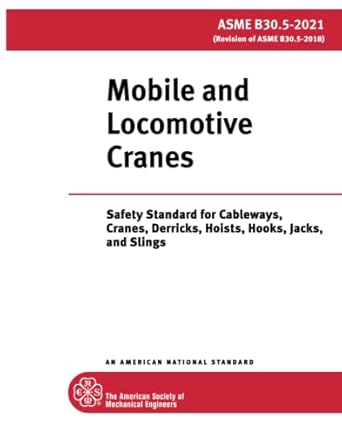
ASME B30.5 – 2021 Mobile and Locomotive Cranes
The ASME B30.5 – 2021 Mobile and Locomotive Cranes offers comprehensive solutions applying to the construction, inspection, testing, maintenance and operation of mobile and locomotive cranes. It is to be used in conjunction with equipment described in other volumes of the ASME B30 series of safety standards. Careful application of these B30 safety standards will help users to comply with applicable regulations within their jurisdictions, while achieving the operational and safety benefits to be gained from the many industry best-practices detailed in these volumes.
$179.99
Book Overview
The ASME B30.5 – 2021 Mobile and Locomotive Cranes is one of ASME’s most requested safety standards—widely respected and applied throughout the building and construction industry. It addresses crawler cranes, locomotive cranes, wheel-mounted cranes, and any variations thereof that retain the same fundamental characteristics and are powered by internal combustion engines or electric motors. The scope of this Safety Standard includes only cranes of the above types that are powered by internal combustion engines or electric motors. Side boom tractors and cranes designed for railway and automobile wreck clearance, digger derricks, cranes manufactured specifically for, or when used for, energized electrical line service, knuckle boom, trolley boom cranes, and cranes having a maximum rated capacity of one ton or less are excluded.
Key aspects:
1. Scope and Coverage
- Applies to mobile cranes (truck-mounted, rough terrain, crawler cranes, etc.) and locomotive cranes (rail-mounted cranes).
- Addresses design, construction, installation, inspection, testing, maintenance, and safe operation.
- Excludes tower cranes and other specific crane types covered in different B30 standards.
2. Crane Types Included
- Rough terrain cranes
- Truck Cranes
- Crawler cranes
- Locomotive (rail-mounted) cranes
- Floating cranes (when mounted on barges or vessels)
3. Safety and Operational Requirements
- Emphasizes safe load handling with proper rigging techniques.
- Requires load charts to be visible and understood by operators.
- Sets criteria for outriggers/stabilizers and ground conditions.
4. Inspection and Maintenance
- Defines inspection types:
- Frequent inspections (daily, before use)
- Periodic inspections (monthly, quarterly, annual)
- Load testing requirements for new cranes, after modifications or repairs.
- Focus on inspecting structural components, wire ropes, brakes, and safety devices.
5. Operator Qualifications and Training
- Requires operators to be trained and certified.
- Calls for understanding of controls, load charts, signals, and safety devices.
6. Safety Devices and Controls
- Mandates safety features such as:
- Load moment indicators (LMI)
- Anti-two-block devices
- Boom angle indicators
- Emergency stop functions
- Load moment indicators (LMI)
7. Environmental and Site Conditions
- Guidance on crane operation under various weather conditions (wind, ice, lightning).
- Requirements for setup on firm ground and precautions to avoid tipping.
8. Modifications and Repairs
- Any crane modifications require engineering evaluation.
- Post-modification inspections and load testing are mandatory.
9. Load Handling and Rigging
- Prohibits unsafe practices such as side loading or overload.
- Emphasizes proper use of slings, hooks, and load balancing.
10. Documentation and Recordkeeping
- Inspection reports, maintenance logs, and operator certifications must be maintained.
Highlights:
- Enhanced clarity on inspection intervals and criteria.
- Updated definitions and terminology for modern crane technology
- Increased focus on operator training and qualification in line with regulatory trends.
- Emphasis on safety device requirements and environmental considerations.
About ASME
The American Society of Mechanical Engineers (ASME) is a nonprofit professional organization founded in 1880 in the United States. It is dedicated to promoting the art, science, and practice of multidisciplinary engineering and allied sciences. ASME develops and publishes consensus-based codes and standards, many of which are globally recognized and widely used in mechanical engineering, energy systems, manufacturing, piping, pressure vessels, and more.
Other Works:
Specifications
| Weight | 3 lbs |
|---|---|
| Dimensions | 11 × 8.5 × 0.5 in |
- Publisher: American Society of Mechanical Engineers (ASME)
- Edition/Release Date: 21st Edition, October 20, 2021
- ISBN: 9780791874714
- Pages: 72
- Format: Paperback / Softbound
- Target Audience: Professionals
Based on 0 reviews
Be the first to review “ASME B30.5 – 2021 Mobile and Locomotive Cranes”
Related products
-
Business and Law, Construction, Industries, Maryland, States
Maryland, Home Improvement Salesperson Reference Guide 6th Edition
 Business and Law, Construction, Industries, Maryland, States
Maryland, Home Improvement Salesperson Reference Guide 6th Edition
Maryland, Home Improvement Salesperson Reference Manual Contractors edition is designed to provide an overview of business management subjects for general contractor examination candidates applying for a license from the Maryland Licensing Board.
SKU: 9781948558273 -
Business and Law, Construction, Industries, North Carolina, States
North Carolina – NASCLA Contractors Guide to Business, Law and Project Management, 10th Edition Spiral-bound
 Business and Law, Construction, Industries, North Carolina, States
North Carolina – NASCLA Contractors Guide to Business, Law and Project Management, 10th Edition Spiral-bound
North Carolina, Business and Project Management for Contractors, General Contractors edition is designed to provide an overview of business management subjects for general contractor examination candidates applying for a license from the North Carolina Licensing Board.
SKU: 9781948558389 -
Construction, Industries, Plumbing, States, West Virginia
Pipefitting Level 4 Trainee Guide, Paperback, 4/E
 Construction, Industries, Plumbing, States, West Virginia
Pipefitting Level 4 Trainee Guide, Paperback, 4/E
08401-07 Advanced Blueprint Reading (50 Hours) Explains how to derive necessary construction information from P&IDs, general arrangement drawings, ISOs, and spool sheets. Includes nine 11 x 17 blueprints. 08402-07 Advanced Pipe Fabrication (50 Hours) Covers the skills needed to layout and fabricate mitered bends, laterals, wyes, and ninety-degree intersections with tables of ordinates or by calculating ordinates with a calculator.
SKU: 9780137487493
There are no reviews yet.