
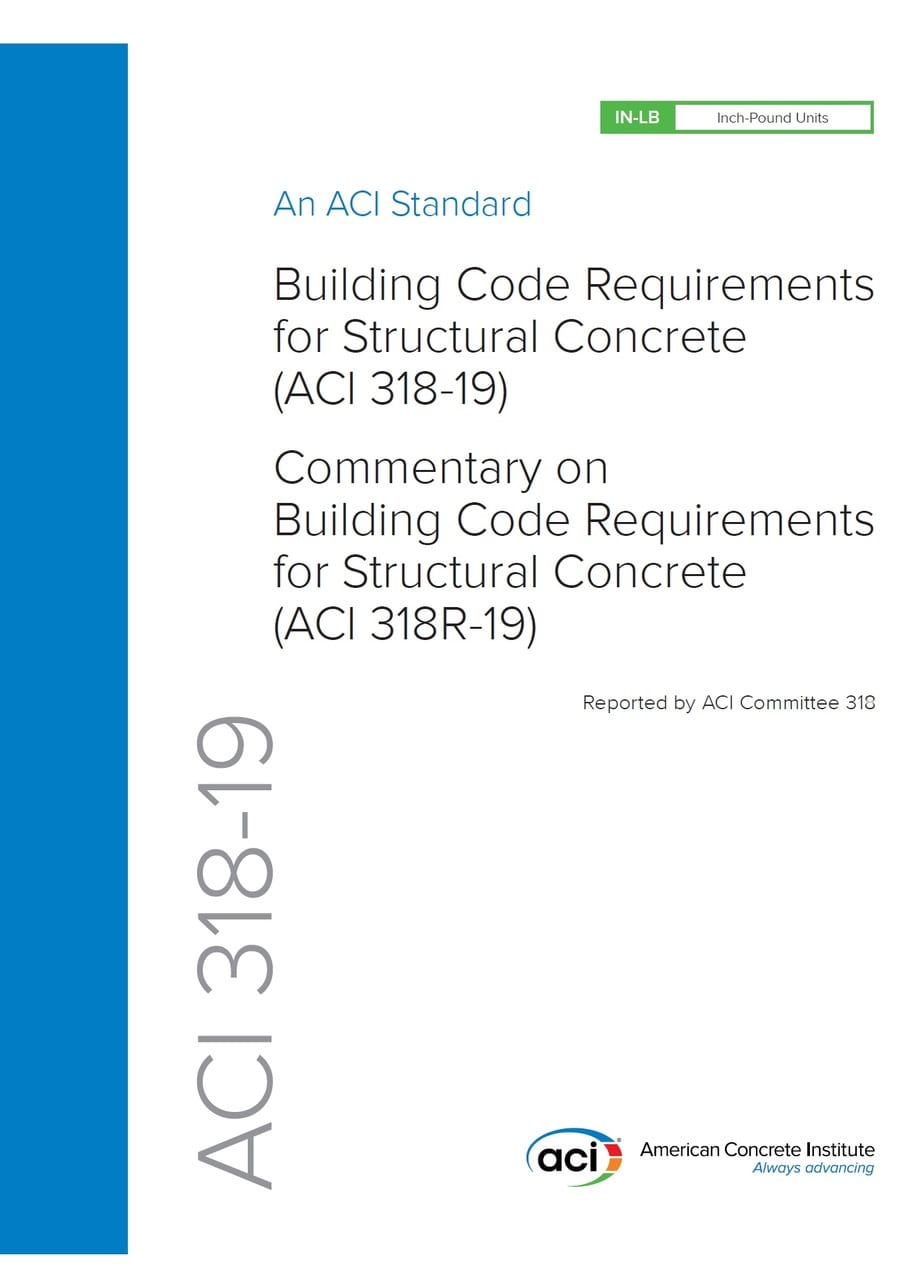
ACI 318-19: Building Code Requirements for Structural Concrete and Commentary
The ACI 318-19: Building Code Requirements for Structural Concrete and Commentary is a comprehensive building code that establishes the minimum requirements for the design and construction of structural concrete buildings and other structures. It provides updated provisions reflecting the latest research and best practices, including the use of high-strength reinforcement, enhanced seismic detailing, and modern durability requirements. The code is organized to guide engineers through material specifications, structural element design, load considerations, and construction practices. Paired with detailed commentary, it serves as both a technical standard and an educational resource, widely adopted in the United States and internationally as a key reference for concrete structural design and code compliance.
$289.99
Book Overview
The ACI 318-19: Building Code Requirements for Structural Concrete and Commentary provides minimum requirements for the materials, design, and detailing of structural concrete buildings and, where applicable, nonbuilding structures. This Code was developed by an ANSI-approved consensus process and addresses structural systems, members, and connections, including cast-in-place, precast, shotcrete, plain, nonprestressed, prestressed, and composite construction. Among the subjects covered are: design and construction for strength, serviceability, and durability; load combinations, load factors, and strength reduction factors; structural analysis methods; deflection limits; mechanical and adhesive anchoring to concrete; development and splicing of reinforcement; construction document information; field inspection and testing; and methods to evaluate the strength of existing structures.
- The Code was substantially reorganized and reformatted in 2014, and this Code continues and expands that same organizational philosophy. The principal objectives of the reorganization were to present all design and detailing requirements for structural systems or for individual members in chapters devoted to those individual subjects, and to arrange the chapters in a manner that generally follows the process and chronology of design and construction. Information and procedures that are common to the design of multiple members are located in utility chapters. Additional enhancements implemented in this Code to provide greater clarity and ease of use include the first use of color illustrations and the use of color to help the user navigate the Code and quickly find the information they need. Special thanks to Bentley Systems, Incorporated, for use of their ProConcrete software to produce many of the figures found in the Commentary.
- Uses of the Code include adoption by reference in a general building code, and earlier editions have been widely used in this manner. The Code is written in a format that allows such reference without change to its language. Therefore, background details or suggestions for carrying out the requirements or intent of the Code provisions cannot be included within the Code itself. The Commentary is provided for this purpose.
- Some considerations of the committee in developing the Code are discussed in the Commentary, with emphasis given to the explanation of new or revised provisions. Much of the research data referenced in preparing the Code is cited for the user desiring to study individual questions in greater detail. Other documents that provide suggestions for carrying out the requirements of the Code are also cited.
- Keywords: admixtures; aggregates; anchorage (structural); beam-column frame; beams (supports); caissons; cements; cold weather; columns (supports); combined stress; composite construction (concrete to concrete); compressive strength; concrete; construction documents; construction joints; continuity (structural); contraction joints; cover; curing; deep beams; deep foundations; deflections; drilled piers; earthquake-resistant structures; flexural strength; floors; footings; formwork (construction); hot weather; inspection; isolation joints; joints (junctions); joists; lightweight concretes; load tests (structural); loads (forces); mixture proportioning; modulus of elasticity; moments; piles; placing; plain concrete; precast concrete; prestressed concrete; prestressing steels; quality control; reinforced concrete; reinforcing steels; roofs; serviceability; shear strength; shotcrete; spans; splicing; strength analysis; stresses; structural analysis; structural design; structural integrity; structural walls; T-beams; torsion; walls; water; welded wire reinforcement.
Key aspects:
- Reorganized Format from ACI 318-14
Maintains the user-friendly format introduced in ACI 318-14, with a structure aligned to the design process (from material selection to structural systems). - Updated for Modern Design Practices
Incorporates the latest research and practices in structural concrete design, including new material models and design methods. - Expanded Use of High-Strength Materials
Allows for reinforcement up to 100 ksi (ASTM A1035), reflecting advancements in material science and construction techniques. - Enhanced Seismic Provisions
Improves detailing and design requirements for earthquake-resisting systems to align with current seismic design standards (ASCE 7-16). - Clarity and Usability
Features clearer language, reorganized sections, and improved references to enhance navigation and comprehension. - International Relevance
Designed with global use in mind, increasing alignment with international concrete design practices and standards. - Robust Commentary
Each section of the code is paired with a detailed commentary that explains the intent and application of the provisions.
Highlights:
- Supports High-Strength Reinforcement
Introduces design provisions for reinforcing bars up to 100 ksi, expanding options for efficient structural design. - Modernized Concrete Design Requirements
Reflects the latest research, materials, and design approaches, including updated load and strength reduction factors. - User-Friendly Organization
Continues the restructured layout from ACI 318-14, improving clarity and code navigation by following the natural design process. - Globally Recognized Standard
Used internationally and often adopted into or referenced by other national design codes. - Enhanced Seismic and Structural Integrity Provisions
Aligns with ASCE 7-16 and includes improved detailing for seismic zones and special structural systems. - Detailed Commentary Section
Provides context, examples, and rationale for each code requirement—making it an invaluable resource for both learning and application. - Aligned with Building Codes
Serves as the referenced concrete design standard in the International Building Code (IBC) and is essential for code compliance in the U.S.
About ACI
The American Concrete Institute (ACI) is a leading nonprofit technical society and standards-developing organization founded in 1904. Based in Farmington Hills, Michigan, ACI is dedicated to advancing knowledge and best practices in concrete design, construction, and materials. It develops and publishes consensus-based codes, specifications, guides, and reports for the concrete industry.
Other Works:
Specifications
| Weight | 4 lbs |
|---|---|
| Dimensions | 11 × 8 × 2.5 in |
- Publisher: American Concrete Institute (ACI)
- Edition/Release Date: 35th Edition, January 1, 2019
- ISBN: 9781641950565
- Pages: 624
- Format: Paperback / Softbound
- Target Audience: Professionals
Based on 0 reviews
Be the first to review “ACI 318-19: Building Code Requirements for Structural Concrete and Commentary”
Related products
-
-
Business and Law, Connecticut, Construction, Industries, States
Connecticut Contractor Guide to Business and Project Management 6th Edition
 Business and Law, Connecticut, Construction, Industries, States
Connecticut Contractor Guide to Business and Project Management 6th Edition
- The Connecticut Contractor Guide to Business and Project Management 6th Edition is a comprehensive resource designed to assist contractors in understanding the legal and business aspects of operating in Connecticut. This guide is particularly useful for those preparing for the Connecticut Business and Law Examination.
SKU: 9781948558235 -
Alabama, Business and Law, Construction, Industries, States, Tabs
Alabama General Contractor Business and Law Tabs
 Alabama, Business and Law, Construction, Industries, States, Tabs
Alabama General Contractor Business and Law Tabs
PERMANENT TABS PACKAGE – This package includes permanent tabs for all references allowed to be used during the exam. •Alabama, Contractor’s Guide to Business and Project Management
SKU: ALBLTABS
There are no reviews yet.