
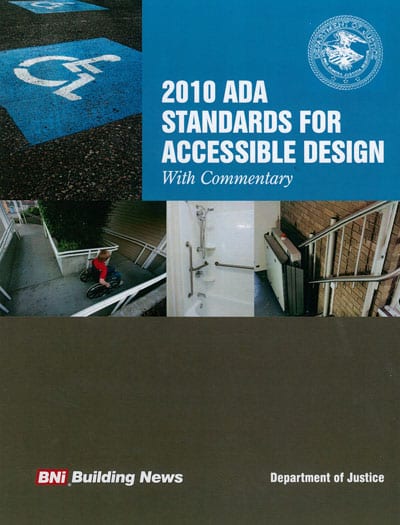
2010 ADA Standards for Accessible Design
As of March 15, 2012 all public parks, hotels, country clubs, universities, restaurants, and even condominiums must comply with far-reaching 2010 ADA Standards. This volume presents the new 2010 Standards side-by-side with explanatory guidance and background.
$78.99
Book Overview
- The 2010 ADA Standards for Accessible Design provide detailed scoping and technical requirements to ensure accessibility in newly designed, constructed, or altered facilities. These standards are organized into several chapters, each focusing on different aspects of accessibility:
- Chapter 1: Application and Administration
This chapter outlines the purpose and scope of the standards, specifying their applicability to various facilities and elements. - Chapter 2: Scoping Requirements
It defines the minimum number of accessible elements required in different types of facilities, ensuring that accessibility is integrated into the design and construction process. - Chapter 3: Building Blocks
This section provides technical requirements for elements such as accessible routes, doorways, and clear floor space, forming the foundation for accessible design. - Chapter 4: Accessible Routes
It specifies the requirements for continuous, unobstructed paths that connect all accessible elements within a facility, accommodating individuals with mobility impairments. - Chapter 5: General Site and Building Elements
This chapter addresses elements like parking spaces, curb ramps, and entrances, ensuring they are designed to be accessible to all users. - Chapter 6: Plumbing Elements and Facilities
It provides guidelines for accessible restrooms, drinking fountains, and other plumbing fixtures, focusing on usability for individuals with disabilities. - Chapter 7: Communication Elements and Features
This section covers requirements for visual and audible communication elements, such as signage and assistive listening systems, to accommodate individuals with sensory impairments. - Chapter 8: Special Rooms, Spaces, and Elements
It details accessibility requirements for specific areas like kitchens, laundry rooms, and recreational facilities, ensuring they are usable by individuals with disabilities. - Chapter 9: Built-In Elements
This chapter addresses built-in elements such as counters, shelves, and work surfaces, specifying their design to be accessible to all users. - Chapter 10: Recreational Facilities
It provides guidelines for accessible design in recreational areas, including play areas, swimming pools, and sports facilities, ensuring inclusivity in recreational spaces.
About ADA
The 2010 ADA Standards for Accessible Design were developed by the U.S. Department of Justice (DOJ), based on the minimum guidelines set by the Access Board, and do not have “authors” in the sense of individual people. Instead, these are the work of these federal agencies, with the Access Board providing the technical foundation and the DOJ issuing them as enforceable federal standards for accessibility in buildings and facilities.
Specifications
| Weight | 5 lbs |
|---|---|
| Dimensions | 11 × 8.5 × 1 in |
- Publisher: U.S. Department of Justice (Author)
- Edition/Release Date: February 20, 2024
- ISBN: 979-8880280445
- Pages: 279 pages
- Format: paperback.
Based on 0 reviews
Be the first to review “2010 ADA Standards for Accessible Design”
Related products
-
Business and Law, Construction, Industries, Maryland, States
Maryland, Home Improvement Salesperson Reference Guide 6th Edition
 Business and Law, Construction, Industries, Maryland, States
Maryland, Home Improvement Salesperson Reference Guide 6th Edition
Maryland, Home Improvement Salesperson Reference Manual Contractors edition is designed to provide an overview of business management subjects for general contractor examination candidates applying for a license from the Maryland Licensing Board.
SKU: 9781948558273 -
Code Books, Construction, Electrical, Industries, Nevada, States, Virginia, Washington D.C.
2011 National Electrical Code
 Code Books, Construction, Electrical, Industries, Nevada, States, Virginia, Washington D.C.
2011 National Electrical Code
NFPA 70®, National Electrical Code® (NEC®), is the authoritative document addressing electrical installations in residential, commercial, and industrial settings. The NEC is revised every three years to stay in sync with industry practices, emerging trends, and the development and introduction of technologies to provide comprehensive rules for designers, installers, inspectors, engineers, electricians, and anyone else who works in the electrical industry. The code is organized for ease of use.
SKU: 7011SB -
Business and Law, Construction, Industries, South Carolina, States
South Carolina, Contractors Guide to Business, Law – Residential
 Business and Law, Construction, Industries, South Carolina, States
South Carolina, Contractors Guide to Business, Law – Residential
South Carolina, Business and Project Management for Contractors, Residential Contractors edition is designed to provide an overview of business management subjects for general contractor examination candidates applying for a license from the South Carolina Licensing Board.
SKU: 1948558068
There are no reviews yet.