
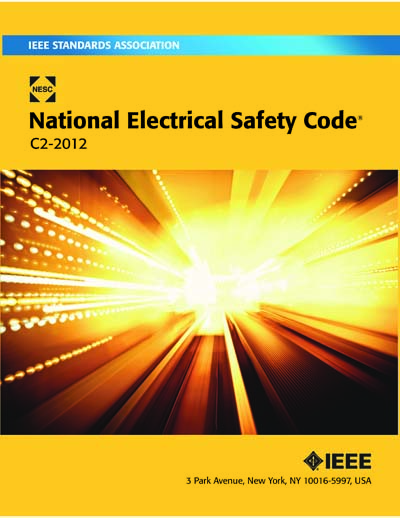
National Electrical Safety Code – 2012
The National Electrical Safety Code – 2012 covers basic provisions for safeguarding of persons from hazards arising from the installation, operation, or maintenance of (1) conductors and equipment in electric supply stations, and (2) overhead and underground electric supply and communication lines. It also includes work rules for the construction, maintenance, and operation of electric supply and communication lines and equipment. The standard is applicable to the systems and equipment operated by utilities, or similar systems and equipment, of an industrial establishment or complex under the control of qualified persons. This standard consists of the introduction, definitions, grounding rules, list of referenced and bibliographic documents, and Parts 1, 2, 3, and 4 of the 2012 Edition of the National Electrical Safety Code.
$318.99
Book Overview
The National Electrical Safety Code – 2012 is a standard published by IEEE that sets forth safety rules and requirements for the installation, operation, and maintenance of electrical supply and communication lines, including overhead and underground lines and associated equipment. It includes work rules covering construction, maintenance, inspection, and safety protocols to protect both workers and the public. Key parts of this edition include revisions to definitions and the scope/applicability, adding clarity especially in situations where it intersects or overlaps the National Electrical Code (NEC). Grounding rules were made more specific to ensure effective and reliable grounding systems. Additional attention was given to safety apparel and arc-rating requirements, tailored minimum approach distances (MADs) for energized work, and updated protective rules for electric supply stations. The 2012 edition is structured into several Parts: introductory sections (definitions, referenced documents, grounding), then Parts 1‑4 which address Supply Stations; Overhead Lines; Underground Lines; and Work Rules. The NESC Handbook (2012, Seventh Edition) accompanies the code, offering explanations of how rules are to be interpreted, historical context, examples, and commentary.
Key aspects:
Revised Minimum Approach Distances (MADs)
- Tailored approach distances based on voltage levels and worker exposure categories.
Expanded Arc-Flash Protection Requirements
- Updated rules on arc-rated clothing and PPE for employees working on or near energized equipment.
Improved Grounding System Rules
- More detailed requirements for system and equipment grounding to enhance reliability and safety.
Clarified Definitions and Scope
- Better delineation of applicability—especially between NESC and the NEC (National Electrical Code).
Updates to Supply Station Rules
- Enhanced safety standards for electric supply stations including clearances and barriers.
Revised Work Rules (Part 4)
- Expanded guidelines for safe work practices including line maintenance and energized work procedures.
Enhanced Requirements for Overhead and Underground Lines
- Updated structural loading, clearances, and installation methods for both line types.
Focus on Compliance and Consistency
- Harmonization with OSHA standards and clearer enforcement language.
Use of Metric and Imperial Units
- Continued dual-unit presentation for global applicability.
Highlights:
- Enhanced Worker Safety
Updated minimum approach distances and arc-flash protection rules reduce risks for employees working near energized equipment. - Stronger Grounding Requirements
More detailed grounding provisions improve system reliability and reduce electrical hazards. - Clearer Scope and Definitions
Better differentiation between NESC and NEC jurisdictions to avoid confusion in electrical installations and maintenance. - Improved Supply Station Standards
New safety protocols for electric supply stations focus on protective barriers and safe clearances. - Comprehensive Work Rules
Expanded safe work practice guidelines addressing energized line work, maintenance, and emergency response. - Up-to-Date Structural and Installation Practices
Modernized rules for overhead and underground line construction, addressing loading, clearances, and material specifications. - Alignment with OSHA and Industry Standards
Consistency with regulatory agencies enhances enforceability and workplace safety.
About David J. Marne
David J. Marne, P.E. is a nationally recognized electrical engineer, author, and educator specializing in utility engineering and the National Electrical Safety Code (NESC). He is best known for authoring the National Electrical Safety Code (NESC) Handbook, which provides detailed commentary and practical guidance on applying NESC rules in real-world scenarios. With over 30 years of experience in the electric utility industry, Marne has worked extensively in overhead and underground line design, substation layout, and electrical safety. He is a Licensed Professional Engineer (P.E.) and the President and Senior Electrical Engineer at Marne and Associates, Inc., a consulting firm that offers training, engineering services, and expert analysis on NESC compliance.
Other Works:
Specifications
| Weight | 4 lbs |
|---|---|
| Dimensions | 11 × 8.5 × 0.5 in |
- Publisher: Institute of Electrical and Electronics Engineers (IEEE)
- Edition/Release Date: 2012 Edition, January 1, 2011
- ISBN: 9780738165882
- Pages: 354
- Format: Spiralbound
- Target Audience: Professionals
Based on 0 reviews
Be the first to review “National Electrical Safety Code – 2012”
Related products
-
Alabama, Business and Law, Construction, Industries, States
Alabama, Contractors Guide to Business and Project Management, Residential 4th Edition
 Alabama, Business and Law, Construction, Industries, States
Alabama, Contractors Guide to Business and Project Management, Residential 4th Edition
Alabama, Business and Project Management for Contractors, General Contractors edition is designed to provide an overview of business management subjects for general contractor examination candidates applying for a license from the Alabama Licensing Board.
SKU: 9781948558204 -
Construction, Industries, Plumbing, States, West Virginia
Pipefitting Level 4 Trainee Guide, Paperback, 4/E
 Construction, Industries, Plumbing, States, West Virginia
Pipefitting Level 4 Trainee Guide, Paperback, 4/E
08401-07 Advanced Blueprint Reading (50 Hours) Explains how to derive necessary construction information from P&IDs, general arrangement drawings, ISOs, and spool sheets. Includes nine 11 x 17 blueprints. 08402-07 Advanced Pipe Fabrication (50 Hours) Covers the skills needed to layout and fabricate mitered bends, laterals, wyes, and ninety-degree intersections with tables of ordinates or by calculating ordinates with a calculator.
SKU: 9780137487493 -
Business and Law, Construction, Industries, Maryland, States
Maryland, Home Improvement Salesperson Reference Guide 6th Edition
 Business and Law, Construction, Industries, Maryland, States
Maryland, Home Improvement Salesperson Reference Guide 6th Edition
Maryland, Home Improvement Salesperson Reference Manual Contractors edition is designed to provide an overview of business management subjects for general contractor examination candidates applying for a license from the Maryland Licensing Board.
SKU: 9781948558273
There are no reviews yet.