
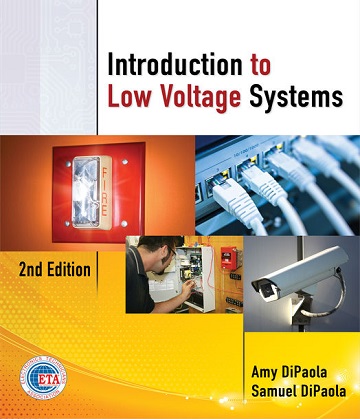
Introduction to Low Voltage Systems, 2nd edition
The Introduction to Low Voltage Systems, 2nd edition is a beginner-friendly textbook that provides a comprehensive overview of various low-voltage systems (e.g., audio, CCTV, fire alarm, networking), explains core theory and devices, and links everything to the National Electrical Code. It’s designed to be accessible to students with basic electrical knowledge, combining conceptual learning with practical code awareness.
$321.99
Book Overview
The Introduction to Low Voltage Systems, 2nd edition is an introductory textbook designed to give readers a solid foundation in the theory, components, and code requirements that govern modern low-voltage technologies. Written for students, apprentices, and entry-level technicians, the book explains the purpose and operation of a wide range of systems—including audio, video, CCTV, security, access control, fire alarm, telecommunication, data networking, and wireless systems—and shows how these systems integrate within residential, commercial, and industrial environments. It introduces essential electrical principles relevant to low-voltage work, such as signal transmission, impedance, grounding, bonding, shielding, and cable construction, while placing strong emphasis on code compliance through detailed discussions of the National Electrical Code and related standards. The text takes a structured, student-friendly approach with clear explanations, defined terminology, and practical examples that link theoretical concepts to real-world applications. Though not intended as a hands-on installation manual, it provides the conceptual groundwork needed to understand how low-voltage systems function, how they are powered and interconnected, and how safety and regulatory requirements shape their design and deployment. Overall, the 2nd edition offers a comprehensive, accessible overview suitable for classroom instruction, self-study, or introductory training in the low-voltage industry.
Key aspects:
- Comprehensive System Coverage: Explores major low-voltage systems such as audio, video, CCTV, fire alarms, telecommunications, data networks, and security/access control.
- Foundation in Electrical Theory: Introduces the signal and circuit principles—resistance, impedance, capacitance, grounding, bonding, and shielding—crucial for understanding system behavior.
- Code-Focused Learning: Emphasizes National Electrical Code requirements and related standards to ensure safe, compliant system design.
- Structured for Education: Features learning objectives, key terms, illustrations, and review questions to reinforce comprehension.
- Integration Across Systems: Shows how different technologies relate, interconnect, and function together in real environments.
- Beginner-Friendly: Written specifically for novices in the low-voltage field, requiring only basic electrical knowledge.
Highlights:
- Clear explanations that make complex technical concepts accessible to new learners.
- Strong emphasis on NEC compliance, grounding safety, and regulatory understanding.
- Broad coverage of technologies, giving readers a wide perspective on the low-voltage industry.
- Useful for classrooms, training programs, and apprenticeships, as well as individual learners.
- Not an installation manual, but a conceptual and theoretical foundation for future technical training.
- Well-organized chapters with defined terminology, aiding both instructors and self-guided learners.
About Authors
Sam DiPaola holds a Power Limited Technician license with the Minnesota Board of Electricity. He is also a registered instructor with the state of Minnesota and the Minnesota Board of Electricity, teaching courses in low voltage continuing education and electronics. He also holds a General Radiotelephone Operator License with the Federal Communications Commission. Mr. DiPaola worked for ten years as an audio technician and an audio systems installer, and later began working in manufacturing with Emerson Process Controls as an electronics design technician. For the past 20 years, Mr. DiPaola has been involved in the design and installation of low voltage systems and automated process controls. Currently, Mr. DiPaola is the Training Director for the Minnesota Statewide Limited Energy JATC Apprenticeship program.
Amy DiPaola holds a Power Limited Technician license with the Minnesota Board of Electricity. She is also a registered instructor with the state of Minnesota and the Minnesota Board of Electricity, teaching courses in low voltage continuing education and electronics. She was an electronics technician with the FBI from 1996-2000 and was a project manager for the installation of security and communication systems at various sites around the country. After leaving the FBI Mrs. DiPaola spent 10 years teaching electronics and electrical systems at multiple technical colleges in Minnesota. In 2009, Mrs. DiPaola started The Minnesota Electrical Training Center, which currently offers continuing education classes to the electrical industry.
Other Works:
| Weight | 5 lbs |
|---|---|
| Dimensions | 11 × 8 × 1 in |
- Publisher: Cengage
- Edition/Release Date: 2nd Edition, February 8, 2012
- ISBN: 9781111639532
- Pages: 448
- Format: Paperback / Softbound
- Target Audience: Professionals
Based on 0 reviews
Be the first to review “Introduction to Low Voltage Systems, 2nd edition”
Related products
-
Business and Law, Construction, Industries, Ohio, States
Ohio, Contractors Guide to Business, Law and Project Management 4th Edition
 Business and Law, Construction, Industries, Ohio, States
Ohio, Contractors Guide to Business, Law and Project Management 4th Edition
Ohio, Business and Project Management for Contractors, General Contractors edition is designed to provide an overview of business management subjects for general contractor examination candidates applying for a license from the Ohio Licensing Board.
SKU: 9781948558426 -
Construction, Industries, Plumbing, States, West Virginia
Pipefitting Level 4 Trainee Guide, Paperback, 4/E
 Construction, Industries, Plumbing, States, West Virginia
Pipefitting Level 4 Trainee Guide, Paperback, 4/E
08401-07 Advanced Blueprint Reading (50 Hours) Explains how to derive necessary construction information from P&IDs, general arrangement drawings, ISOs, and spool sheets. Includes nine 11 x 17 blueprints. 08402-07 Advanced Pipe Fabrication (50 Hours) Covers the skills needed to layout and fabricate mitered bends, laterals, wyes, and ninety-degree intersections with tables of ordinates or by calculating ordinates with a calculator.
SKU: 9780137487493 -
Arizona, Business and Law, Construction, Industries, States
ARIZONA-NASCLA Contractors Guide to Business, Law and Project Management, Arizona 7th Edition
 Arizona, Business and Law, Construction, Industries, States
ARIZONA-NASCLA Contractors Guide to Business, Law and Project Management, Arizona 7th Edition
Arizona, Business and Project Management for Contractors, General Contractors edition is designed to provide an overview of business management subjects for general contractor examination candidates applying for a license from the Arizona Licensing Board.
SKU: 9781948558181

There are no reviews yet.