
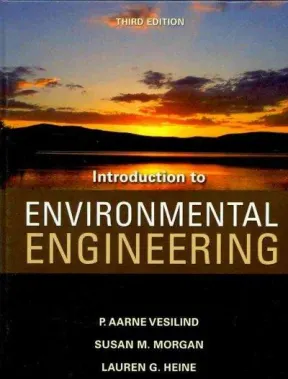
Introduction to Environmental Engineering, 3rd Ed
The Introduction to Environmental Engineering, 3rd Ed provides a comprehensive, accessible introduction to environmental engineering and science for undergraduate engineering and science students. It emphasizes not only the technical foundations of the field (mass and energy balances, reaction engineering, transport, and separations) but also the real-world environmental challenges and ethical considerations that engineers must grapple with.
$277.99
Book Overview
The Introduction to Environmental Engineering, 3rd Ed presents a balanced treatment of environmental engineering by combining engineering concepts with the importance of environmental ethics. This third edition highlights sustainable development and emphasizes the need for engineers to become even more environmentally responsible during this time of increasing awareness of environmental concerns. The authors challenge students with problems that require not only a technical solution but a thorough consideration of its ethical ramifications. The text also provides comprehensive exposure to all types of environmental problems, including ecosystem dynamics, wastewater treatment, and air pollution control.
Key aspects:
- Balanced Coverage: The book treats all major categories of pollution (water, air, solid waste, and hazardous waste) while integrating contemporary and emerging environmental issues such as climate change, ozone depletion, and risk assessment.
- Fundamental Principles: It begins with core concepts in mass and energy transfer, then moves into environmental chemistry, reaction kinetics, and transport phenomena.
- Quantitative Tools: Students learn how to perform engineering calculations, including material balances, separation processes, and reactor design—skills essential for understanding treatment systems.
- Risk Assessment and Sustainability: There’s a strong emphasis on risk-analysis methodologies, environmental health risks, and sustainable development practices.
- Water Quality Engineering: Detailed discussion of water pollution, including water supply, treatment processes, and pollution control strategies.
- Air Pollution & Global Change: The book covers air pollution control methods and explores global atmospheric change, tying in how engineering solutions intersect with worldwide environmental trends.
- Solid Waste and Resource Recovery: There’s also coverage of solid waste management, recycling, and resource recovery strategies—core to modern environmental engineering.
- Ethics and Regulation: Ethical issues (e.g., environmental justice, green engineering) and legal/regulatory frameworks are woven throughout, helping students understand the societal context of engineering decisions.
- Pedagogical Support: End-of-chapter review problems, case studies, and real-world examples help students apply theoretical ideas to practical environmental problems.
Highlights:
- Accessible Introduction: Ideal for undergraduates with minimal prior background.
- Real-World Applications: Connects theory to practical environmental problems.
- Comprehensive Approach: Covers technical, social, and ethical dimensions of environmental engineering.
- Structured Learning: Organized progression from fundamentals to advanced topics.
- Sustainability Focus: Emphasizes sustainable practices and responsible engineering solutions.
About Authors
Gilbert M. Masters was a professor of civil and environmental engineering, known for his contributions to environmental engineering education. He authored several textbooks on environmental engineering and science, emphasizing practical applications, problem-solving, and accessibility for undergraduate students. His work has influenced generations of engineers in understanding water and air quality, pollution control, and environmental sustainability.
Wendell P. Ela is an environmental engineer and educator with expertise in water and wastewater treatment, air quality management, and environmental systems. He has co-authored textbooks to provide students with both the technical foundations and practical tools needed to address real-world environmental challenges.
Other Works:
Specifications
| Weight | 5 lbs |
|---|---|
| Dimensions | 11 × 8.5 × 2 in |
- Publisher: Pearson
- Edition/Release Date: 3rd Edition, June 8, 2007
- ISBN: 9780131481930
- Pages: 720
- Format: Paperback / Softbound
- Target Audience: Professionals
Based on 0 reviews
Be the first to review “Introduction to Environmental Engineering, 3rd Ed”
Related products
-
Alabama, Business and Law, Construction, Industries, States
Alabama, Business and Project Management, General Contractors, 3rd edition
 Alabama, Business and Law, Construction, Industries, States
Alabama, Business and Project Management, General Contractors, 3rd edition
Alabama, Business and Project Management for Contractors, General Contractors edition is designed to provide an overview of business management subjects for general contractor examination candidates applying for a license from the Alabama Licensing Board.
SKU: 9781934234556 -
Business and Law, Construction, Industries, South Carolina, States, Tabs
South Carolina Residential Business and Project Permanent Tabs
 Business and Law, Construction, Industries, South Carolina, States, Tabs
South Carolina Residential Business and Project Permanent Tabs
PERMANENT TABS PACKAGE – This package includes permanent tabs for all references allowed to be used during the exam.
•South Carolina, Contractor’s Guide to Business and Project Management
SKU: SCRESBLTABS -
-
Business and Law, Construction, Industries, South Carolina, States
South Carolina, Contractors Guide to Business, Law – Residential
 Business and Law, Construction, Industries, South Carolina, States
South Carolina, Contractors Guide to Business, Law – Residential
South Carolina, Business and Project Management for Contractors, Residential Contractors edition is designed to provide an overview of business management subjects for general contractor examination candidates applying for a license from the South Carolina Licensing Board.
SKU: 1948558068
There are no reviews yet.