
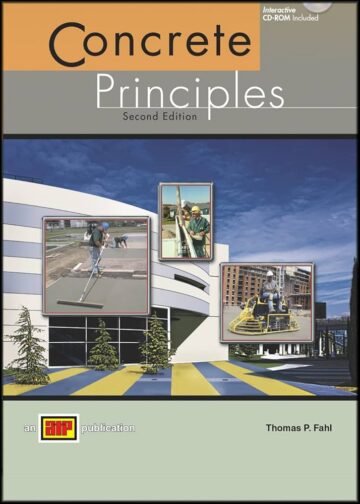
Concrete Principles
The Concrete Principles begins with an introduction to the history, evolution, and characteristics of concrete as a principal construction material. Subsequent chapters provide an overview of the tools and equipment commonly used in the industry, and concrete construction procedures including soil conditions and preparation, flatwork, concrete structures, concrete consolidation, and concrete finishing. The remaining chapters cover tool and equipment maintenance, concrete quality, testing and repair, and concrete construction estimating. Each text contains an IBM-compatible CD-ROM in the back of the book that contains Chapter Quick Quizzes®, an illustrated Glossary, and related web links to educational resources. Concrete Principles provides detailed coverage of current practices used in the concrete industry. Step-by-step placement, consolidation, and finishing procedures for flatwork and structures are featured, as well as formwork and reinforcement requirements.
$116.99
Book Overview
The Concrete Principles is a comprehensive textbook that explores the full gamut of materials, techniques, and practices used in modern concrete construction. Authored by Thomas P. Fahl and published in 2009 by American Technical Publishers, it corresponds closely with the curriculum of the Operative Plasterers’ & Cement Masons’ International Association of the U.S. & Canada. The book begins with foundational discussions — history, evolution, and characteristics of concrete — then progresses into more technical and hands‑on topics such as tools, equipment safety, concrete exposure safety, soil conditions, flatwork (slabs, floors, etc.), consolidation, finishing techniques, formwork, reinforcement, quality testing, repair practices, and estimating. It also contains updated material on newer technologies and special concrete types: pervious concrete; precast and tilt‑up methods; slip and flying forms; insulated concrete forms (ICFs); grouting and epoxy injection; self‑consolidating concrete; reactive powder concrete; and sustainable design including LEED certification
Key aspects:
Comprehensive Coverage
Covers the entire scope of concrete work—from basic materials and tools to advanced techniques like precast and tilt-up construction.
Educational Alignment
Developed in coordination with the Operative Plasterers’ & Cement Masons’ International Association, making it ideal for apprenticeship and training programs.
Safety & Health Emphasis
Includes detailed guidance on safety around tools, equipment, chemical exposure, and formwork hazards, aligning with OSHA standards.
Modern Concrete Technologies
Introduces advanced materials and methods such as:
- Self-consolidating concrete (SCC)
- Pervious concrete
- Reactive powder concrete
- Grouting and epoxy injection
- Insulated concrete forms (ICFs)
Sustainable Construction
Covers green practices including LEED certification, low-carbon mixes, and energy-efficient concrete systems.
Structural Elements
Discusses placement and finishing of slabs, walls, columns, and specialty forms (e.g., flying forms, slipforms).
Testing & Quality Control
Explains slump testing, curing methods, strength testing, and how to identify/repair defects like cracks or honeycombing.
Estimating & Planning
Teaches how to calculate quantities of concrete, reinforcement, and labor for job planning and cost estimating.
Highlights:
- Industry-Backed Textbook
Developed in partnership with the Operative Plasterers’ & Cement Masons’ International Association, ensuring relevance to real-world trade skills. - Strong Foundation in Concrete Basics
Explains the science of concrete — mix design, hydration, curing, and physical properties — in clear, practical terms. - Covers Modern Methods & Materials
Includes updates on pervious concrete, self-consolidating concrete (SCC), reactive powder concrete, ICFs, tilt-up panels, and more. - Emphasis on Safety
Includes complete sections on tool safety, chemical exposure, formwork hazards, and OSHA compliance. - Hands-On Focus
Provides step-by-step instructions for placing, finishing, repairing, and testing concrete in various jobsite scenarios. - Sustainability Awareness
Introduces concepts of green concrete, LEED certification, and energy-efficient construction.
About Thomas P. Fahl
Thomas P. Fahl is a seasoned educator and author specializing in construction education, particularly in concrete and masonry trades. He has developed training materials and textbooks used across vocational schools, apprenticeship programs, and industry certification courses. Fahl worked closely with the Operative Plasterers’ & Cement Masons’ International Association (OPCMIA) to ensure that his work aligns with union training standards and national trade curricula. Known for his clear writing style and practical focus, Fahl’s contributions have helped standardize and elevate training in the concrete construction industry. His work bridges classroom learning and field application, making him a respected figure in trade education circles.
Other Works:
Specifications
| Weight | 2 lbs |
|---|---|
| Dimensions | 11 × 8.5 × 1 in |
- Publisher: American Technical Publishers
- Edition/Release Date: 2nd Edition, January 20, 2009
- ISBN: 9780826905123
- Pages: 372
- Format: Paperback / Softbound
- Target Audience: Professionals
Based on 0 reviews
Be the first to review “Concrete Principles”
Related products
-
Alabama, Business and Law, Construction, Industries, States, Tabs
Alabama General Contractor Business and Law Tabs
 Alabama, Business and Law, Construction, Industries, States, Tabs
Alabama General Contractor Business and Law Tabs
PERMANENT TABS PACKAGE – This package includes permanent tabs for all references allowed to be used during the exam. •Alabama, Contractor’s Guide to Business and Project Management
SKU: ALBLTABS -
Alabama, Business and Law, Construction, Industries, States
Alabama, Business and Project Management, General Contractors, 3rd edition
 Alabama, Business and Law, Construction, Industries, States
Alabama, Business and Project Management, General Contractors, 3rd edition
Alabama, Business and Project Management for Contractors, General Contractors edition is designed to provide an overview of business management subjects for general contractor examination candidates applying for a license from the Alabama Licensing Board.
SKU: 9781934234556 -
Business and Law, Connecticut, Construction, Industries, States
Connecticut Contractor Guide to Business and Project Management 6th Edition
 Business and Law, Connecticut, Construction, Industries, States
Connecticut Contractor Guide to Business and Project Management 6th Edition
- The Connecticut Contractor Guide to Business and Project Management 6th Edition is a comprehensive resource designed to assist contractors in understanding the legal and business aspects of operating in Connecticut. This guide is particularly useful for those preparing for the Connecticut Business and Law Examination.
SKU: 9781948558235

There are no reviews yet.