
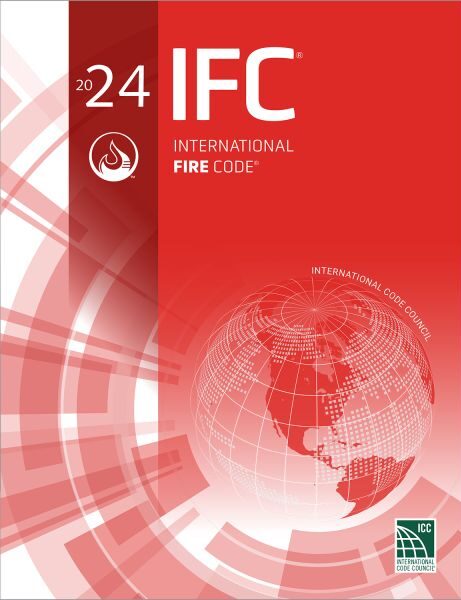
2024 International Fire Code (International Code Council Series)
The 2024 International Fire Code contains regulations to safeguard life and property from fires and explosion hazards. Topics include general precautions, emergency planning and preparedness, fire department access and water supplies, automatic sprinkler systems, fire alarm systems, special hazards, and the storage and use of hazardous materials.
$169.99
Book Overview
The 2024 International Fire Code (IFC), developed by the International Code Council (ICC), is a comprehensive and enforceable fire safety standard used by fire officials, building inspectors, architects, and engineers across jurisdictions to regulate and safeguard life and property from fire and explosion hazards. This edition integrates provisions that govern fire prevention, building design related to fire resistance, hazardous materials handling, emergency planning, fire protection systems, and maintenance of fire-safety features. It covers topics such as occupancy classification, fire service access, means of egress, fire alarm and sprinkler systems, and hazardous materials storage and use. The 2024 update includes critical revisions based on new fire science, stakeholder input, and technological advancements—ensuring alignment with modern fire prevention practices. With clearly organized chapters, comprehensive tables, and detailed definitions, the IFC supports both daily enforcement and long-term planning efforts.
Key aspects:
- Energy Storage Systems (ESS). Continued focus on ESS. Now referencing NFPA 855 along with IFC Section 1207 to regulate Energy Storage systems. The provisions continue to evolve with technologies.
- Lithium-ion batteries. Research, storage, and manufacturing of such technologies are being regulated through active systems including automatic sprinkler systems and detection requirements along with proper overall building design and construction. The IFC contains a specific section to provide tools to manage the collection of lithium-ion batteries.
- Powered micromobility devices. A section dedicated to the hazards associated with charging such devices are addressed in the IFC. This includes a number of requirements focusing on issues such as product listings, separation requirements, and use of detection systems.
- Carbon Monoxide (CO) detection. The 2024 IBC and IFC now require CO alarms or detection systems for all types of occupancies. Previously the focus was only on residential and schools.
- A2L refrigerants. The IFC and IBC now acknowledge the need for the use of A2L (flammable) refrigerants but in a safe and well-regulated way. The code now acknowledges two hazard levels for flammable gases based upon the Global Harmonized Standards (GHS).
- Distilled spirits and wine storage. Fire protection requirements have been further refined based upon data from FM Global.
- Valet trash. Valet trash collection is now permitted only where approved. The owner and valet trash collection service provider are required to comply with the rules and limitations that are established by the jurisdiction. Appendix O has been added to provide requirements for adoption.
- Inflatable amusement devices. Section 3107 has been added to provide requirements for these devices.
- Temporary Heating and Cooking Operations. A new Chapter 41 provides all the requirements, including some relocated from other chapters in the 2021 edition, that address temporary heating and cooking operations.
- Emergency Responder Communications Enhancement System (ERCES). Provisions in Section 510 have been updated to match the latest terminology and technology being used for ERCES. In addition, NFPA 1225-2022 Standard for Emergency Services Communications, is now referenced.
Highlights:
- Single column text format and modernized font styles improves readability
- QR Codes replace vertical margin sidebars and arrows to identify code changes more accurately
- Shading for table headers and notes improves locating tables and applicable notes
- Grouping of associated content brings tables and figures immediately after the parent section.
About ICC
International Code Council is a leading organization dedicated to developing a single set of comprehensive, coordinated national model construction codes. To date, 48 U.S. states have adopted various international codes from the International Code Council.
Other Works
Specifications
| Weight | 5 lbs |
|---|---|
| Dimensions | 11 × 8 × 3 in |
- Publisher: International Code Council
- Edition/Release Date: February 27, 2024
- ISBN: 9781959851660
- Pages: 664
- Format: Softcover
- Target Audience: Professionals
Based on 0 reviews
Be the first to review “2024 International Fire Code (International Code Council Series)”
Related products
-
-
Arizona, Business and Law, Construction, Industries, States
ARIZONA-NASCLA Contractors Guide to Business, Law and Project Management, Arizona 7th Edition
 Arizona, Business and Law, Construction, Industries, States
ARIZONA-NASCLA Contractors Guide to Business, Law and Project Management, Arizona 7th Edition
Arizona, Business and Project Management for Contractors, General Contractors edition is designed to provide an overview of business management subjects for general contractor examination candidates applying for a license from the Arizona Licensing Board.
SKU: 9781948558181 -
Business and Law, Construction, Industries, States, Virginia
Virginia, NASCLA Contractors Guide to Business and Project Management, 11th Edition
 Business and Law, Construction, Industries, States, Virginia
Virginia, NASCLA Contractors Guide to Business and Project Management, 11th Edition
Virginia, Business and Project Management for Contractors, Commercial Contractors edition is designed to provide an overview of business management subjects for general contractor examination candidates applying for a license from the Virginia Licensing Board.
SKU: 9781948558457 -
Business and Law, Construction, Industries, South Carolina, States, Tabs
South Carolina Residential Business and Project Permanent Tabs
 Business and Law, Construction, Industries, South Carolina, States, Tabs
South Carolina Residential Business and Project Permanent Tabs
PERMANENT TABS PACKAGE – This package includes permanent tabs for all references allowed to be used during the exam.
•South Carolina, Contractor’s Guide to Business and Project Management
SKU: SCRESBLTABS
There are no reviews yet.