
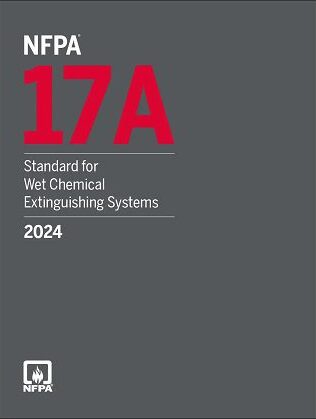
NFPA 17A, Standard for Wet Chemical Extinguishing Systems 2024 Edition
Fire suppression systems and equipment play a critical role in reducing loss and protecting lives in the event of an emergency. NFPA 17A, Standard for Wet Chemical Extinguishing Systems, provides requirements for designing, installing, operating, testing, and maintaining these systems through their life cycle. Provisions focus on helping to improve the integrity and reliability of equipment designed to discharge wet chemicals from fixed nozzles and piping by means of expellant gas. Content is relevant to systems utilized in restaurants and institutional hoods, plenums, ducts, and related cooking appliances, covering everything from components to plans and acceptance testing and inspection, maintenance, and recharging. Major revisions to the 2024 edition include: New Annex G detailing common deficiencies and impairments. Definitions of deficiency and impairment have also been added to clarify how users should differentiate between these two types of issues. Annex B has been deleted, because the information was incorporated into Chapter 6 in the prior (2021) edition.
$203.99
Book Overview
The 2024 edition of NFPA 17A expands its scope and refines safety protocols for wet chemical extinguishing systems, especially in commercial cooking and mobile equipment applications.
Here’s a detailed breakdown of what’s new and important in the 2024 edition of NFPA 17A: Standard for Wet Chemical Extinguishing Systems:
Purpose and Scope
- NFPA 17A establishes the minimum requirements for the design, installation, maintenance, and testing of pre-engineered wet chemical fire extinguishing systems.
- These systems are primarily used to protect commercial cooking equipment, including hoods, ducts, filters, and appliances, from fire hazards caused by grease and oils.
Key Updates in the 2024 Edition
- Expanded Application: A new Chapter 6 addresses wet chemical extinguishing systems for mobile equipment, aligning with similar provisions in NFPA 17 (dry chemical systems).
- Deficiency vs. Impairment: The terms are now clearly differentiated:
Deficiency: A condition that could prevent the system from functioning properly.
Impairment: A condition that renders the system inoperative.
Examples of each are provided in Annex C. - Enhanced System Integrity: New provisions aim to improve the dependability and mechanical integrity
About NFPA
NFPA is known as the trusted source of safety knowledge, the National Fire Protection Association (NFPA) has been helping to solve some of the planet’s toughest safety problems for more than 125 years. To remain relevant for over a century as a knowledge and information organization, we’ve continually evolved our scope of expertise—from fire prevention, wildfire preparedness, and electrical safety to hazardous materials, community risk reduction, and public safety.
Other Works:
Specifications
| Weight | 2 lbs |
|---|---|
| Dimensions | 11 × 8.5 × 0.5 in |
- Publisher: NFPA
- Edition/Release Date: January 1, 2023
- ISBN: 9781455930425
- Pages: 27
- Format: Paperback / Softbound
- Target Audience: Professionals
Based on 0 reviews
Be the first to review “NFPA 17A, Standard for Wet Chemical Extinguishing Systems 2024 Edition”
Related products
-
Construction, HVAC-R, Industries, States, Texas, Utah
Manual S – Residential Equipment Selection
Manual S is the essential companion to Manual J! It shows you how to select and size heating and cooling equipment to meet Manual J loads based on local climate and ambient conditions at the building site. Manual S covers sizing strategies for all types of cooling and heating equipment, as well as how to use comprehensive manufacturer’s performance data on sensible, latent, or heating capacity for various operating conditions.
SKU: 36MANUALS -
Business and Law, Construction, Industries, North Carolina, States
North Carolina – NASCLA Contractors Guide to Business, Law and Project Management, 10th Edition Spiral-bound
 Business and Law, Construction, Industries, North Carolina, States
North Carolina – NASCLA Contractors Guide to Business, Law and Project Management, 10th Edition Spiral-bound
North Carolina, Business and Project Management for Contractors, General Contractors edition is designed to provide an overview of business management subjects for general contractor examination candidates applying for a license from the North Carolina Licensing Board.
SKU: 9781948558389 -
Business and Law, Construction, Industries, Maryland, States
Maryland, Home Improvement Salesperson Reference Guide 6th Edition
 Business and Law, Construction, Industries, Maryland, States
Maryland, Home Improvement Salesperson Reference Guide 6th Edition
Maryland, Home Improvement Salesperson Reference Manual Contractors edition is designed to provide an overview of business management subjects for general contractor examination candidates applying for a license from the Maryland Licensing Board.
SKU: 9781948558273 -
Alabama, Alaska, Arizona, Connecticut, Construction, Florida, Georgia, Hawaii, Industries, Maryland, Math & Plans, Mississippi, Nevada, New Jersey, New Mexico, Ohio, Oklahoma, Plumbing, South Carolina, States, Tennessee, Virginia
Mathematics for Plumbers and Pipefitters 8th Edition
 Alabama, Alaska, Arizona, Connecticut, Construction, Florida, Georgia, Hawaii, Industries, Maryland, Math & Plans, Mississippi, Nevada, New Jersey, New Mexico, Ohio, Oklahoma, Plumbing, South Carolina, States, Tennessee, Virginia
Mathematics for Plumbers and Pipefitters 8th Edition
Now in its 8th edition, Mathematics for Plumbers and Pipefitters delivers the essential math skills necessary in the plumbing and pipefitting professions.
SKU: 9781111642600
There are no reviews yet.