
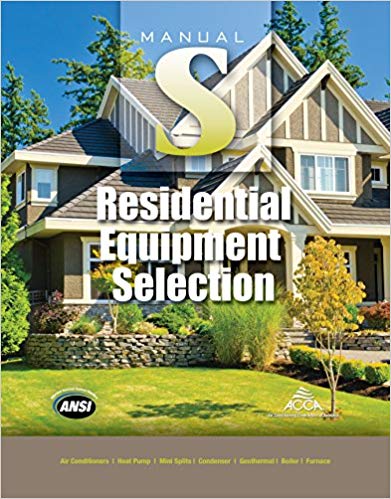
Manual S – Residential Equipment Selection
Manual S is the essential companion to Manual J! It shows you how to select and size heating and cooling equipment to meet Manual J loads based on local climate and ambient conditions at the building site. Manual S covers sizing strategies for all types of cooling and heating equipment, as well as how to use comprehensive manufacturer’s performance data on sensible, latent, or heating capacity for various operating conditions.
$99.99
Book Overview
Manual S provides procedures for selecting and sizing residential HVAC equipment based on specific design conditions, including local climate and home construction characteristics. It emphasizes the importance of matching equipment capacities to the calculated heating and cooling loads to prevent issues such as short cycling, excessive humidity, and increased energy consumption.
Key Aspects:
- Comprehensive performance data compared with ARI directory data for air conditioners and heat pumps, and the presentation formats used by different manufacturers.
- How ventilation loads and air distribution system loads affect equipment size and performance.
- How to determine the condition of the air approaching the cooling coil when outdoor air is introduced into the return side of the duct system, including specific tables and charts.
- Cooling-only equipment, air-to-air heat pumps, water-to-air heat pumps, dual fuel heat pumps, multispeed and variable speed equipment.
- Why the “400 CFM per ton rule” is a myth, why the blower CFM is exclusively defined by the sensible heat equation, why lower DX coil air flow rates are compatible with humid climates, and why water source refrigeration cycle equipment should not be sized to satisfy the design heating load.
Highlights:
- Expanded Equipment Coverage: The 2023 edition includes guidance for a broader range of equipment types, accommodating the industry’s shift towards electrification and variable-capacity systems.
- Variable-Capacity Equipment Guidance: Recognizing the increased use of variable-capacity equipment, the standard provides expanded guidance to ensure proper selection and sizing.
- Code Compliance Support: Manual S assists in demonstrating compliance with the International Residential Code (IRC) and the Uniform Mechanical Code, providing minimum documentation requirements.
- Dehumidification and Humidification: The manual offers expanded guidance on the use of dehumidifiers and humidifiers to improve indoor air quality and comfort.
About ACCA
The Air Conditioning Contractors of America (ACCA), a leading trade association for HVAC professionals in the United States. While specific individual authors are not publicly credited, the manual is developed by a committee of industry experts, engineers, and professionals with extensive experience in HVAC system design. These contributors work collaboratively to ensure the manual reflects current industry practices, standards, and technological advancements.
Other Works:
Specifications
| Weight | 2 lbs |
|---|---|
| Dimensions | 11 × 8.5 × 1 in |
- Publisher: Air Conditioning Contractors of America (ACCA)
- Edition/Release Date: 2nd Edition, January 1, 2014
- ISBN: 978-1892765581
- Pages: 328
- Format: Paperback / Softbound
- Target Audience: Professionals
Based on 0 reviews
Be the first to review “Manual S – Residential Equipment Selection”
Related products
-
Business and Law, Construction, Industries, States, Virginia
Virginia, NASCLA Contractors Guide to Business and Project Management, 11th Edition
 Business and Law, Construction, Industries, States, Virginia
Virginia, NASCLA Contractors Guide to Business and Project Management, 11th Edition
Virginia, Business and Project Management for Contractors, Commercial Contractors edition is designed to provide an overview of business management subjects for general contractor examination candidates applying for a license from the Virginia Licensing Board.
SKU: 9781948558457 -
Business and Law, Construction, Industries, Maryland, States
Maryland, Home Improvement Salesperson Reference Guide 6th Edition
 Business and Law, Construction, Industries, Maryland, States
Maryland, Home Improvement Salesperson Reference Guide 6th Edition
Maryland, Home Improvement Salesperson Reference Manual Contractors edition is designed to provide an overview of business management subjects for general contractor examination candidates applying for a license from the Maryland Licensing Board.
SKU: 9781948558273 -
Business and Law, Construction, Industries, South Carolina, States
South Carolina, Contractors Guide to Business, Law – Residential
 Business and Law, Construction, Industries, South Carolina, States
South Carolina, Contractors Guide to Business, Law – Residential
South Carolina, Business and Project Management for Contractors, Residential Contractors edition is designed to provide an overview of business management subjects for general contractor examination candidates applying for a license from the South Carolina Licensing Board.
SKU: 1948558068 -
Business and Law, Connecticut, Construction, Industries, States
Connecticut Contractor Guide to Business and Project Management 6th Edition
 Business and Law, Connecticut, Construction, Industries, States
Connecticut Contractor Guide to Business and Project Management 6th Edition
- The Connecticut Contractor Guide to Business and Project Management 6th Edition is a comprehensive resource designed to assist contractors in understanding the legal and business aspects of operating in Connecticut. This guide is particularly useful for those preparing for the Connecticut Business and Law Examination.
SKU: 9781948558235
There are no reviews yet.