
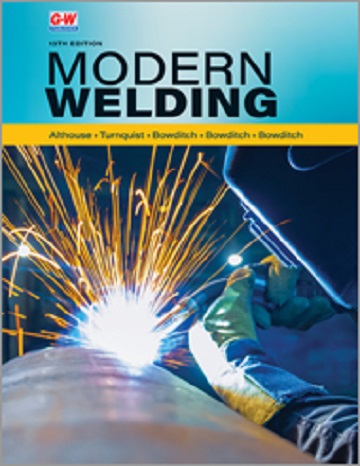
Modern Welding, 13th Edition
Modern Welding is a comprehensive text that has long been the standard for teaching theory, fundamentals, equipment, and techniques of welding technology, with enough information to span a two-year curriculum. Covering all of the information required for complete AWS SENSE Level 1 and Level 2 certification, this text includes shielded metal arc welding, gas metal arc welding, flux cored arc welding, gas tungsten arc welding, oxyfuel gas welding and cutting, various thermal cutting processes, testing and inspection, welding symbol interpretation, and print reading. The text also includes Nonstandard Terminology features, introducing students to the jargon commonly used in the welding industry to help them communicate effectively on the job.
- Includes 30 step-by-step procedures that guide students through challenging welding-related operations
- Features a time-saving Quick Reference Table of Contents that directs students to the specific reference tables in the book
- Presents safety information in bold red type throughout the text to reinforce and highlight this critical information
$208.99
Book Overview
The Modern Welding, 13th Edition is a comprehensive and authoritative textbook intended for students, instructors, apprentices, and professionals in welding and related trades. Published by Goodheart‑Willcox, the revised edition is tailored to span a full two‑year welding curriculum, covering both foundational theory and advanced techniques. It is aligned to meet the requirements of AWS SENSE Level 1 and Level 2 certification programs. The content includes detailed treatment of all major welding and cutting processes currently used in industry: shielded metal arc welding (SMAW), gas metal arc welding (GMAW), flux‑cored arc welding, gas tungsten arc welding (GTAW), oxyfuel gas welding and cutting, and various thermal cutting methods. In addition to process instruction, the book includes sections on welding inspection and testing, print reading, welding symbol interpretation, safety, and nonstandard (trade) terminology. This edition also emphasizes practical, applied learning. It includes 30 step‑by‑step procedures that guide students through challenging welding‑related operations. Safety is heavily underscored: general shop safety and safety attitudes are introduced early, and safety information is highlighted in bold red throughout the text. The manual also provides numerous tables and charts (e.g. for recommended amperage, voltage, electrode size, welding speed, gas pressures, etc.), which serve as quick references for students and practitioners. Visually, Modern Welding, 13th Edition is richly illustrated with full‐color photographs and color‑coded drawings that help clarify each process and its equipment. The layout allows flexibility: chapters can be studied sequentially, or specific welding processes can be studied in isolation, depending on instructional needs. Metric (SI) and U.S. customary units are used throughout. Overall, this edition combines theoretical background, hands‑on technique, industry standards, and safety practices into a single, up‑to‑date resource, aiming to prepare students for both on‑the‑job performance and AWS certification.
Key aspects:
- Comprehensive Welding Coverage
- Aligned with AWS SENSE Standards
- Strong Emphasis on Safety
- Welding Symbols and Blueprint Reading
- Inspection and Testing
- Customary and Metric Units
- Flexible Curriculum Integration
- Career Readiness Focus
Highlights:
- Updated to Reflect Current Industry Standards
- 30 Step-by-Step Weld Procedures
- Color-Coded Visuals & Diagrams
About Authors
William A. Bowditch – has an extensive teaching and welding background. He has been a teacher, department head, and supervisor of special needs and vocational programs. In addition to his formal college training in preparation for teaching, Bill has taken several specialized courses in industry, such as the Hobart Welding School and American Welding Society courses. He is a member of the Association for Career and Technical Education and a life member of the American Welding Society. As a coauthor of Modern Welding, he has guided this Goodheart-Willcox book through many revisions to keep it up to date and technically correct in order to maintain its value as an authoritative welding text. He is also a coauthor of Welding Fundamentals.
Kevin E. Bowditch – Kevin E. Bowditch is a retired welding engineer specialist for Subaru of Indiana Automotive Inc. His welding experience includes working for two automotive firms, two aerospace firms, a construction company (building nuclear plants), and a precision sheet metal firm. His initial welding training was at the Hobart Institute of Welding Technology. He earned his bachelor’s degree in welding engineering from The Ohio State University, and has attended specialized conferences and courses sponsored by the American Welding Society, American Society of Mechanical Engineers, and American National Standards Institute. At Subaru, he helped develop and validate welding parameters to make over one billion spot and arc welds per year. Kevin Bowditch joined his father as a coauthor of Modern Welding, beginning with the 1984 edition, and has been a coauthor of Welding Fundamentals since its first edition was published in 1991.
Other Works:
Specifications
| Weight | 5 lbs |
|---|---|
| Dimensions | 11 × 8.5 × 2.5 in |
- Publisher: Goodheart‑Willcox
- Edition/Release Date: 13th Edition, January 9, 2023
- ISBN: 9781685845711
- Pages: 928
- Format: Paperback / Softbound
- Target Audience: Professionals
Based on 0 reviews
Be the first to review “Modern Welding, 13th Edition”
Related products
-
Business and Law, Construction, Industries, Maryland, States
Maryland, Home Improvement Salesperson Reference Guide 6th Edition
 Business and Law, Construction, Industries, Maryland, States
Maryland, Home Improvement Salesperson Reference Guide 6th Edition
Maryland, Home Improvement Salesperson Reference Manual Contractors edition is designed to provide an overview of business management subjects for general contractor examination candidates applying for a license from the Maryland Licensing Board.
SKU: 9781948558273 -
Code Books, Construction, Electrical, Industries, Nevada, States, Virginia, Washington D.C.
2011 National Electrical Code
 Code Books, Construction, Electrical, Industries, Nevada, States, Virginia, Washington D.C.
2011 National Electrical Code
NFPA 70®, National Electrical Code® (NEC®), is the authoritative document addressing electrical installations in residential, commercial, and industrial settings. The NEC is revised every three years to stay in sync with industry practices, emerging trends, and the development and introduction of technologies to provide comprehensive rules for designers, installers, inspectors, engineers, electricians, and anyone else who works in the electrical industry. The code is organized for ease of use.
SKU: 7011SB -
Business and Law, Construction, Industries, South Carolina, States, Tabs
South Carolina Residential Business and Project Permanent Tabs
 Business and Law, Construction, Industries, South Carolina, States, Tabs
South Carolina Residential Business and Project Permanent Tabs
PERMANENT TABS PACKAGE – This package includes permanent tabs for all references allowed to be used during the exam.
•South Carolina, Contractor’s Guide to Business and Project Management
SKU: SCRESBLTABS
There are no reviews yet.